15 Billion Scam Ads a Day: What Big Tech's Fraud Problem Means for Brands
Reuters reported that Meta internally projected billions in annual revenue from scam and banned goods ads. Here is why Big Tech fraud is now a brand protection issue.
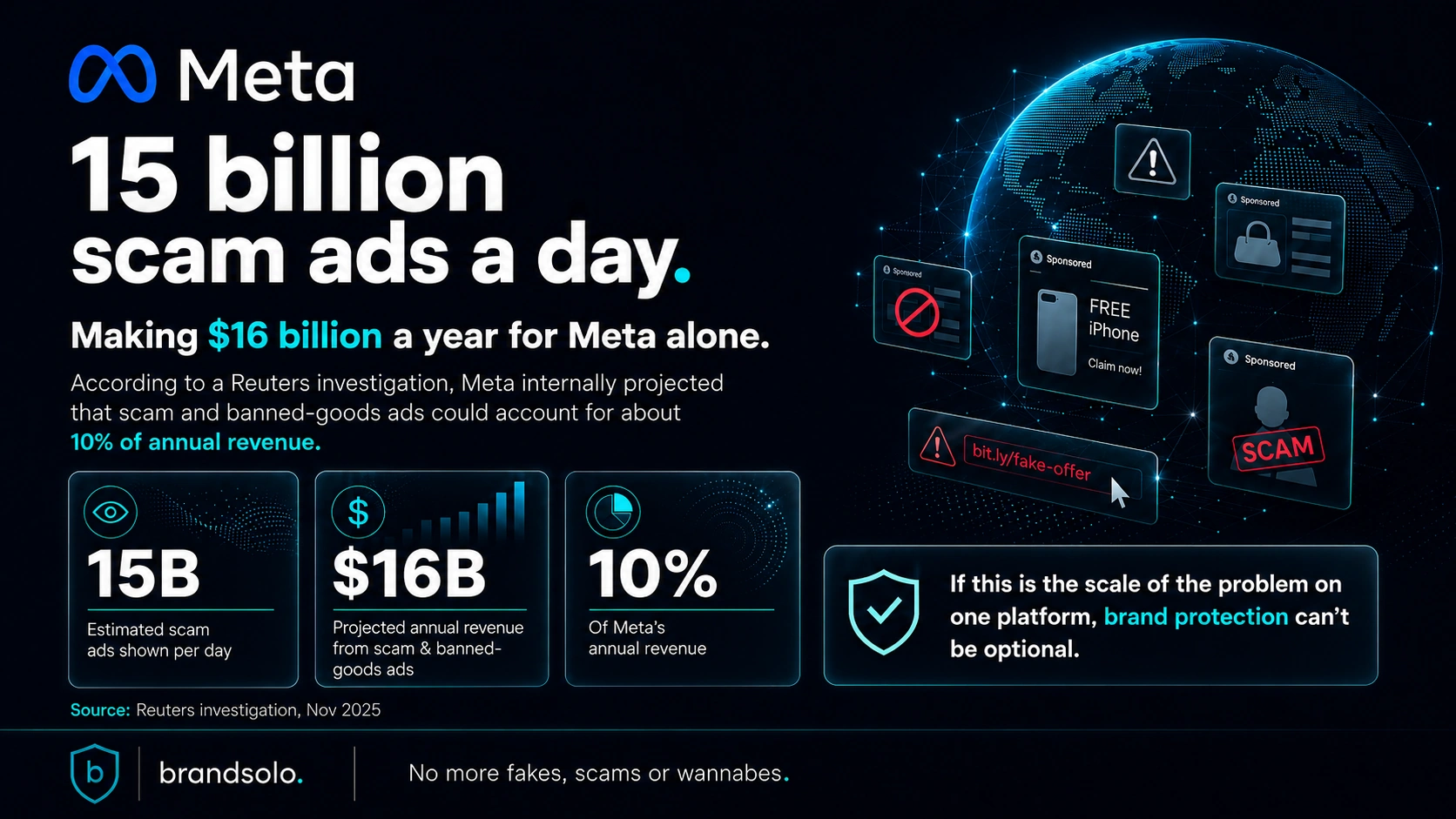
That is roughly 10% of Meta's annual revenue.
Meta disputes Reuters' framing and said the internal estimate was rough and overly inclusive. That context matters. But for brands, the broader signal is still hard to ignore.
Scam ads are no longer a side issue.
They are part of the digital economy brands now have to defend themselves against.
According to Reuters, Meta internally projected it could make around $16 billion a year from scam and banned goods ads. The same investigation reported that Meta platforms show users an estimated 15 billion scam ads a day.
This is not just a Meta issue
The uncomfortable question is not only about one platform.
Big Tech platforms do not need to sell the fake product themselves to profit from the system around it.
Marketplaces like Amazon can earn from seller fees, fulfilment, advertising and traffic, while brands and consumers carry the damage from scam ads, fake shops, unauthorised sellers and counterfeit products.
That is the platform incentive problem.
The abuse sits across the chain. The money can sit across the chain too.
The chain of damage
- A scam ad creates attention.
- A fake domain creates trust.
- A fake shop captures payment.
- A counterfeit listing steals demand.
- The brand carries the damage.
Most platforms still work from the wrong default
Most platforms treat a product, ad, seller or webshop as legitimate until someone proves otherwise.
For brands, that creates a serious operational gap.
A fake ad can be live before a brand sees it. A scam domain can collect payments before a legal team has opened a case. A counterfeit marketplace listing can redirect demand before a platform review starts.
By the time the abuse is visible internally, consumers may already have been misled.
That is why brand protection can no longer be limited to occasional takedown requests or manual searches. The speed of abuse has changed. The operating model has to change with it.
Scam ads, fake shops and counterfeits are now connected
Online abuse used to be easier to separate.
A fake product listing was a marketplace problem. A scam website was a domain problem. A misleading ad was a social media problem. An unauthorised seller was a distribution problem.
That separation no longer reflects how abuse actually works.
Scammers use social ads to create attention. They use fake domains and webshops to capture trust and payment. They use marketplace listings to create product supply and perceived legitimacy. They use copied images, brand names, discounts and product language to make everything feel real.
For the consumer, this does not look like a platform issue.
It looks like the brand.
That is where the damage starts.
Brands increasingly need a connected view across Social Media Protection, Marketplace & Webshop Protection and Domain Shield.
The cost is bigger than one lost sale
For brands, the damage is commercial and reputational.
Consumers lose money. Official sales channels lose demand. Customer support teams get questions about products they never sold. Retail partners lose trust. Legal teams lose time. Brand equity gets diluted.
And when fake products are poor quality, unsafe or linked to criminal supply chains, the reputational risk becomes even bigger.
The consumer rarely knows who is responsible for the abuse. They remember the brand name they saw.
Why this matters for brands, artists and public figures
This issue is especially relevant for brands with strong consumer trust, large fan communities or high demand products.
That includes fashion brands, sports teams, artists, festivals, entertainment brands, e-commerce retailers, celebrities and public figures.
The stronger the brand signal, the more attractive it becomes for abuse.
Scammers borrow the trust that brands have spent years building. Then they use that trust to drive traffic, clicks, payments and counterfeit demand.
That is why the problem is not only legal. It is commercial.
Brand protection protects trust, revenue and the consumer relationship.
What brands should do now
Brands need to look at the full abuse chain, not just one platform.
That means monitoring and enforcement across:
- Social ads
- Social commerce
- Marketplaces
- Scam domains
- Fake webshops
- Unauthorised sellers
- Counterfeit product listings
The key is not just finding abuse. The key is proving what is fake, validating it properly and acting fast enough to reduce damage.
That requires a combination of technology, human validation and platform specific enforcement routes.
AI can help surface the scale. Human review is still critical to avoid false positives, protect authorised sellers and separate real abuse from legitimate commerce.
Where Brandsolo comes in
Brandsolo helps brands find and remove fake ads, scam domains, fake shops and counterfeit products before they steal attention, trust and revenue.
We work across marketplaces, domains, webshops, social ads and social commerce, connecting the dots between channels that are often treated separately.
Because the abuse chain is connected now.
And brands need to protect the full chain.
The takeaway
15 billion scam ads a day is not just a shocking number.
It is a warning sign.
When fraud and abuse become this profitable, brands cannot wait for platforms to solve everything for them.
Scam ads, scam domains, fake shops and large scale counterfeiting are not side issues anymore.
They are now part of the digital economy brands, artists and consumers have to defend themselves against.
No more fakes, scams or wannabes.
Sources
Reuters Special Report: Meta is earning a fortune on a deluge of fraudulent ads, documents show